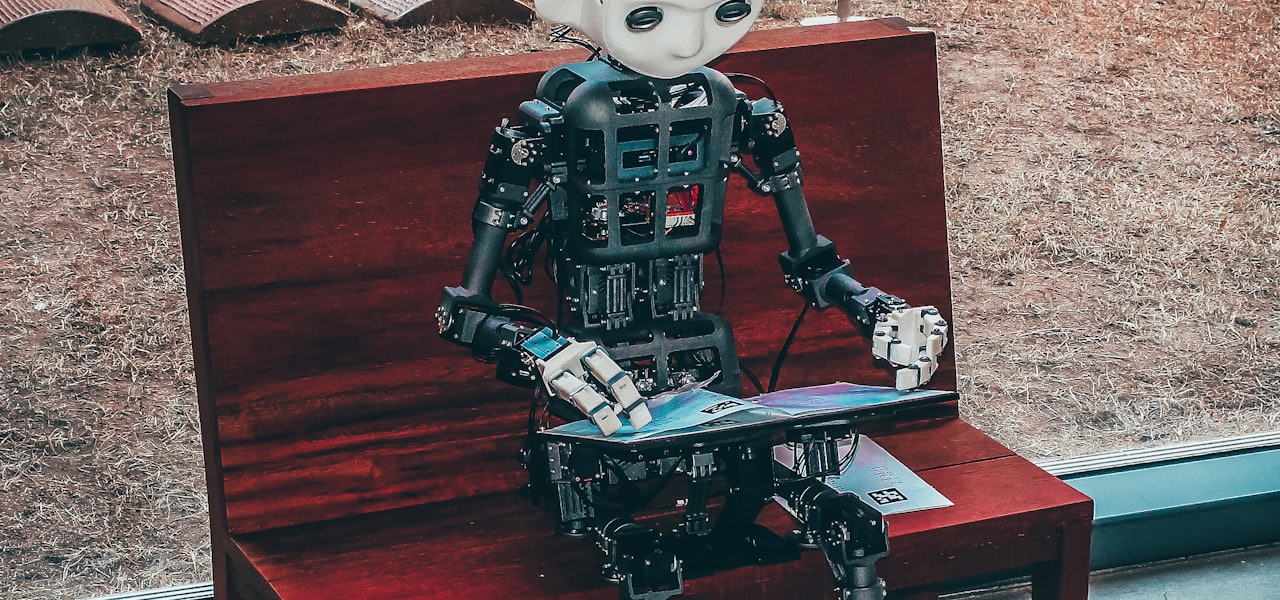
The Old Axolotl (Polish: Starość aksolotla) is a 2015 digital-only novel by Polish science-fiction author Jacek Dukaj. The novel was released in Polish on March 10, 2015, and shortly afterward, on March 24 that year, in English (translated by Stanley Bill). It has been described as "an experiment in reading (and creating) the electronic literature of the future". It is Dukaj's first novel to be published in English, though several of his short stories (The Golden Galley, 1996, The Iron General, 2010, The Apocrypha of Lem, 2011) have been translated prior to this. The novel has inspired two Netflix original series: the 2020 Belgian Into the Night, and its 2022 Turkish language spin-off Yakamoz S-245. == Plot == The novel presents a post-apocalyptic, cyberpunk vision of Earth where biological life has been wiped out, inhabited by robots and mechs, many of which are humans whose consciousness has been digitized in the wake of an extinction event. == Significance and analysis == The novel is an example of electronic literature, available only in digital formats, and has no traditional paper version. It was designed from the beginning not only to incorporate more traditional elements such as illustrations, but also hypertext, and 3D-printable models of main robotic characters designed by Alex Jaeger, the art director of Transformers films. The novel composition is layered, with the narrative layer, an encyclopedic/hyperlinked footnote layer, and a multimedia layer, including illustrations and a short promotional video by the Oscar-nominated Platige Image studio. One of the novel's central questions is: "What does it mean to be human?" Other subjects include post humanism and other "staples of cyberpunk and related genres, such as the artificial intelligence". The novel is representative of Dukaj's prose, posing philosophical questions about the future of man and technology. The author explained that: "stories such as The Old Axolotl that model an ‘escape from the body’ are born out of a sense of progress as a process of ‘de-animalising’ human beings through science. This has its origin in the pre-Enlightenment intuition of ‘liberation from nature’. For one of the last shackles of nature is corporeality itself, the limitations of our physicality." The other major element of the novel is Dukaj's attempts to introduce the reader to the new style of electronic literature. The novel was nominated for the 2016 Janusz A. Zajdel Award.
Hyperparameter (machine learning)
In machine learning, a hyperparameter is a parameter that can be set in order to define any configurable part of a model's learning process. Hyperparameters can be classified as either model hyperparameters (such as the topology and size of a neural network) or algorithm hyperparameters (such as the learning rate and the batch size of an optimizer). These are named hyperparameters in contrast to parameters, which are characteristics that the model learns from the data. Hyperparameters are not required by every model or algorithm. Some simple algorithms such as ordinary least squares regression require none. However, the LASSO algorithm, for example, adds a regularization hyperparameter to ordinary least squares which must be set before training. Even models and algorithms without a strict requirement to define hyperparameters may not produce meaningful results if these are not carefully chosen. However, optimal values for hyperparameters are not always easy to predict. Some hyperparameters may have no meaningful effect, or one important variable may be conditional upon the value of another. Often a separate process of hyperparameter tuning is needed to find a suitable combination for the data and task. As well as improving model performance, hyperparameters can be used by researchers to introduce robustness and reproducibility into their work, especially if it uses models that incorporate random number generation. == Considerations == The time required to train and test a model can depend upon the choice of its hyperparameters. A hyperparameter is usually of continuous or integer type, leading to mixed-type optimization problems. The existence of some hyperparameters is conditional upon the value of others, e.g. the size of each hidden layer in a neural network can be conditional upon the number of layers. === Difficulty-learnable parameters === The objective function is typically non-differentiable with respect to hyperparameters. As a result, in most instances, hyperparameters cannot be learned using gradient-based optimization methods (such as gradient descent), which are commonly employed to learn model parameters. These hyperparameters are those parameters describing a model representation that cannot be learned by common optimization methods, but nonetheless affect the loss function. An example would be the tolerance hyperparameter for errors in support vector machines. === Untrainable parameters === Sometimes, hyperparameters cannot be learned from the training data because they aggressively increase the capacity of a model and can push the loss function to an undesired minimum (overfitting to the data), as opposed to correctly mapping the richness of the structure in the data. For example, if we treat the degree of a polynomial equation fitting a regression model as a trainable parameter, the degree would increase until the model perfectly fit the data, yielding low training error, but poor generalization performance. === Tunability === Most performance variation can be attributed to just a few hyperparameters. The tunability of an algorithm, hyperparameter, or interacting hyperparameters is a measure of how much performance can be gained by tuning it. For an LSTM, while the learning rate followed by the network size are its most crucial hyperparameters, batching and momentum have no significant effect on its performance. Although some research has advocated the use of mini-batch sizes in the thousands, other work has found the best performance with mini-batch sizes between 2 and 32. === Robustness === An inherent stochasticity in learning directly implies that the empirical hyperparameter performance is not necessarily its true performance. Methods that are not robust to simple changes in hyperparameters, random seeds, or even different implementations of the same algorithm cannot be integrated into mission critical control systems without significant simplification and robustification. Reinforcement learning algorithms, in particular, require measuring their performance over a large number of random seeds, and also measuring their sensitivity to choices of hyperparameters. Their evaluation with a small number of random seeds does not capture performance adequately due to high variance. Some reinforcement learning methods, e.g. DDPG (Deep Deterministic Policy Gradient), are more sensitive to hyperparameter choices than others. == Optimization == Hyperparameter optimization finds a tuple of hyperparameters that yields an optimal model which minimizes a predefined loss function on given test data. The objective function takes a tuple of hyperparameters and returns the associated loss. Typically these methods are not gradient based, and instead apply concepts from derivative-free optimization or black box optimization. == Reproducibility == Apart from tuning hyperparameters, machine learning involves storing and organizing the parameters and results, and making sure they are reproducible. In the absence of a robust infrastructure for this purpose, research code often evolves quickly and compromises essential aspects like bookkeeping and reproducibility. Online collaboration platforms for machine learning go further by allowing scientists to automatically share, organize and discuss experiments, data, and algorithms. Reproducibility can be particularly difficult for deep learning models. For example, research has shown that deep learning models depend very heavily even on the random seed selection of the random number generator.
Generalized distributive law
The generalized distributive law (GDL) is a generalization of the distributive property which gives rise to a general message passing algorithm. It is a synthesis of the work of many authors in the information theory, digital communications, signal processing, statistics, and artificial intelligence communities. The law and algorithm were introduced in a semi-tutorial by Srinivas M. Aji and Robert J. McEliece with the same title. == Introduction == "The distributive law in mathematics is the law relating the operations of multiplication and addition, stated symbolically, a ∗ ( b + c ) = a ∗ b + a ∗ c {\displaystyle a(b+c)=ab+ac} ; that is, the monomial factor a {\displaystyle a} is distributed, or separately applied, to each term of the binomial factor b + c {\displaystyle b+c} , resulting in the product a ∗ b + a ∗ c {\displaystyle ab+ac} " – Britannica. As it can be observed from the definition, application of distributive law to an arithmetic expression reduces the number of operations in it. In the previous example the total number of operations reduced from three (two multiplications and an addition in a ∗ b + a ∗ c {\displaystyle ab+ac} ) to two (one multiplication and one addition in a ∗ ( b + c ) {\displaystyle a(b+c)} ). Generalization of distributive law leads to a large family of fast algorithms. This includes the FFT and Viterbi algorithm. This is explained in a more formal way in the example below: α ( a , b ) = d e f ∑ c , d , e ∈ A f ( a , c , b ) g ( a , d , e ) {\displaystyle \alpha (a,\,b){\stackrel {\mathrm {def} }{=}}\displaystyle \sum \limits _{c,d,e\in A}f(a,\,c,\,b)\,g(a,\,d,\,e)} where f ( ⋅ ) {\displaystyle f(\cdot )} and g ( ⋅ ) {\displaystyle g(\cdot )} are real-valued functions, a , b , c , d , e ∈ A {\displaystyle a,b,c,d,e\in A} and | A | = q {\displaystyle |A|=q} (say) Here we are "marginalizing out" the independent variables ( c {\displaystyle c} , d {\displaystyle d} , and e {\displaystyle e} ) to obtain the result. When we are calculating the computational complexity, we can see that for each q 2 {\displaystyle q^{2}} pairs of ( a , b ) {\displaystyle (a,b)} , there are q 3 {\displaystyle q^{3}} terms due to the triplet ( c , d , e ) {\displaystyle (c,d,e)} which needs to take part in the evaluation of α ( a , b ) {\displaystyle \alpha (a,\,b)} with each step having one addition and one multiplication. Therefore, the total number of computations needed is 2 ⋅ q 2 ⋅ q 3 = 2 q 5 {\displaystyle 2\cdot q^{2}\cdot q^{3}=2q^{5}} . Hence the asymptotic complexity of the above function is O ( n 5 ) {\displaystyle O(n^{5})} . If we apply the distributive law to the RHS of the equation, we get the following: α ( a , b ) = d e f ∑ c ∈ A f ( a , c , b ) ⋅ ∑ d , e ∈ A g ( a , d , e ) {\displaystyle \alpha (a,\,b){\stackrel {\mathrm {def} }{=}}\displaystyle \sum \limits _{c\in A}f(a,\,c,\,b)\cdot \sum _{d,\,e\in A}g(a,\,d,\,e)} This implies that α ( a , b ) {\displaystyle \alpha (a,\,b)} can be described as a product α 1 ( a , b ) ⋅ α 2 ( a ) {\displaystyle \alpha _{1}(a,\,b)\cdot \alpha _{2}(a)} where α 1 ( a , b ) = d e f ∑ c ∈ A f ( a , c , b ) {\displaystyle \alpha _{1}(a,b){\stackrel {\mathrm {def} }{=}}\displaystyle \sum \limits _{c\in A}f(a,\,c,\,b)} and α 2 ( a ) = d e f ∑ d , e ∈ A g ( a , d , e ) {\displaystyle \alpha _{2}(a){\stackrel {\mathrm {def} }{=}}\displaystyle \sum \limits _{d,\,e\in A}g(a,\,d,\,e)} Now, when we are calculating the computational complexity, we can see that there are q 3 {\displaystyle q^{3}} additions in α 1 ( a , b ) {\displaystyle \alpha _{1}(a,\,b)} and α 2 ( a ) {\displaystyle \alpha _{2}(a)} each and there are q 2 {\displaystyle q^{2}} multiplications when we are using the product α 1 ( a , b ) ⋅ α 2 ( a ) {\displaystyle \alpha _{1}(a,\,b)\cdot \alpha _{2}(a)} to evaluate α ( a , b ) {\displaystyle \alpha (a,\,b)} . Therefore, the total number of computations needed is q 3 + q 3 + q 2 = 2 q 3 + q 2 {\displaystyle q^{3}+q^{3}+q^{2}=2q^{3}+q^{2}} . Hence the asymptotic complexity of calculating α ( a , b ) {\displaystyle \alpha (a,b)} reduces to O ( n 3 ) {\displaystyle O(n^{3})} from O ( n 5 ) {\displaystyle O(n^{5})} . This shows by an example that applying distributive law reduces the computational complexity which is one of the good features of a "fast algorithm". == History == Some of the problems that used distributive law to solve can be grouped as follows: Decoding algorithms: A GDL like algorithm was used by Gallager's for decoding low density parity-check codes. Based on Gallager's work Tanner introduced the Tanner graph and expressed Gallagers work in message passing form. The tanners graph also helped explain the Viterbi algorithm. It is observed by Forney that Viterbi's maximum likelihood decoding of convolutional codes also used algorithms of GDL-like generality. Forward–backward algorithm: The forward backward algorithm helped as an algorithm for tracking the states in the Markov chain. And this also was used the algorithm of GDL like generality Artificial intelligence: The notion of junction trees has been used to solve many problems in AI. Also the concept of bucket elimination used many of the concepts. == The MPF problem == MPF or marginalize a product function is a general computational problem which as special case includes many classical problems such as computation of discrete Hadamard transform, maximum likelihood decoding of a linear code over a memory-less channel, and matrix chain multiplication. The power of the GDL lies in the fact that it applies to situations in which additions and multiplications are generalized. A commutative semiring is a good framework for explaining this behavior. It is defined over a set K {\displaystyle K} with operators " + {\displaystyle +} " and " . {\displaystyle .} " where ( K , + ) {\displaystyle (K,\,+)} and ( K , . ) {\displaystyle (K,\,.)} are a commutative monoids and the distributive law holds. Let p 1 , … , p n {\displaystyle p_{1},\ldots ,p_{n}} be variables such that p 1 ∈ A 1 , … , p n ∈ A n {\displaystyle p_{1}\in A_{1},\ldots ,p_{n}\in A_{n}} where A {\displaystyle A} is a finite set and | A i | = q i {\displaystyle |A_{i}|=q_{i}} . Here i = 1 , … , n {\displaystyle i=1,\ldots ,n} . If S = { i 1 , … , i r } {\displaystyle S=\{i_{1},\ldots ,i_{r}\}} and S ⊂ { 1 , … , n } {\displaystyle S\,\subset \{1,\ldots ,n\}} , let A S = A i 1 × ⋯ × A i r {\displaystyle A_{S}=A_{i_{1}}\times \cdots \times A_{i_{r}}} , p S = ( p i 1 , … , p i r ) {\displaystyle p_{S}=(p_{i_{1}},\ldots ,p_{i_{r}})} , q S = | A S | {\displaystyle q_{S}=|A_{S}|} , A = A 1 × ⋯ × A n {\displaystyle \mathbf {A} =A_{1}\times \cdots \times A_{n}} , and p = { p 1 , … , p n } {\displaystyle \mathbf {p} =\{p_{1},\ldots ,p_{n}\}} Let S = { S j } j = 1 M {\displaystyle S=\{S_{j}\}_{j=1}^{M}} where S j ⊂ { 1 , . . . , n } {\displaystyle S_{j}\subset \{1,...\,,n\}} . Suppose a function is defined as α i : A S i → R {\displaystyle \alpha _{i}:A_{S_{i}}\rightarrow R} , where R {\displaystyle R} is a commutative semiring. Also, p S i {\displaystyle p_{S_{i}}} are named the local domains and α i {\displaystyle \alpha _{i}} as the local kernels. Now the global kernel β : A → R {\displaystyle \beta :\mathbf {A} \rightarrow R} is defined as: β ( p 1 , . . . , p n ) = ∏ i = 1 M α ( p S i ) {\displaystyle \beta (p_{1},...\,,p_{n})=\prod _{i=1}^{M}\alpha (p_{S_{i}})} Definition of MPF problem: For one or more indices i = 1 , . . . , M {\displaystyle i=1,...\,,M} , compute a table of the values of S i {\displaystyle S_{i}} -marginalization of the global kernel β {\displaystyle \beta } , which is the function β i : A S i → R {\displaystyle \beta _{i}:A_{S_{i}}\rightarrow R} defined as β i ( p S i ) = ∑ p S i c ∈ A S i c β ( p ) {\displaystyle \beta _{i}(p_{S_{i}})\,=\displaystyle \sum \limits _{p_{S_{i}^{c}}\in A_{S_{i}^{c}}}\beta (p)} Here S i c {\displaystyle S_{i}^{c}} is the complement of S i {\displaystyle S_{i}} with respect to { 1 , . . . , n } {\displaystyle \mathbf {\{} 1,...\,,n\}} and the β i ( p S i ) {\displaystyle \beta _{i}(p_{S_{i}})} is called the i t h {\displaystyle i^{th}} objective function, or the objective function at S i {\displaystyle S_{i}} . It can observed that the computation of the i t h {\displaystyle i^{th}} objective function in the obvious way needs M q 1 q 2 q 3 ⋯ q n {\displaystyle Mq_{1}q_{2}q_{3}\cdots q_{n}} operations. This is because there are q 1 q 2 ⋯ q n {\displaystyle q_{1}q_{2}\cdots q_{n}} additions and ( M − 1 ) q 1 q 2 . . . q n {\displaystyle (M-1)q_{1}q_{2}...q_{n}} multiplications needed in the computation of the i th {\displaystyle i^{\text{th}}} objective function. The GDL algorithm which is explained in the next section can reduce this computational complexity. The following is an example of the MPF problem. Let p 1 , p 2 , p 3 , p 4 , {\displaystyle p_{1},\,p_{2},\,p_{3},\,p_{4},} and p 5 {\displaystyle p_{5}} be variables such that p 1 ∈ A 1 , p 2 ∈ A 2 , p 3 ∈ A 3 , p 4 ∈ A 4 , {\displaystyle p_{1}\in
Grid-oriented storage
Grid-oriented Storage (GOS) was a term used for data storage by a university project during the era when the term grid computing was popular. == Description == GOS was a successor of the term network-attached storage (NAS). GOS systems contained hard disks, often RAIDs (redundant arrays of independent disks), like traditional file servers. GOS was designed to deal with long-distance, cross-domain and single-image file operations, which is typical in Grid environments. GOS behaves like a file server via the file-based GOS-FS protocol to any entity on the grid. Similar to GridFTP, GOS-FS integrates a parallel stream engine and Grid Security Infrastructure (GSI). Conforming to the universal VFS (Virtual Filesystem Switch), GOS-FS can be pervasively used as an underlying platform to best utilize the increased transfer bandwidth and accelerate the NFS/CIFS-based applications. GOS can also run over SCSI, Fibre Channel or iSCSI, which does not affect the acceleration performance, offering both file level protocols and block level protocols for storage area network (SAN) from the same system. In a grid infrastructure, resources may be geographically distant from each other, produced by differing manufacturers, and have differing access control policies. This makes access to grid resources dynamic and conditional upon local constraints. Centralized management techniques for these resources are limited in their scalability both in terms of execution efficiency and fault tolerance. Provision of services across such platforms requires a distributed resource management mechanism and the peer-to-peer clustered GOS appliances allow a single storage image to continue to expand, even if a single GOS appliance reaches its capacity limitations. The cluster shares a common, aggregate presentation of the data stored on all participating GOS appliances. Each GOS appliance manages its own internal storage space. The major benefit of this aggregation is that clustered GOS storage can be accessed by users as a single mount point. GOS products fit the thin-server categorization. Compared with traditional “fat server”-based storage architectures, thin-server GOS appliances deliver numerous advantages, such as the alleviation of potential network/grid bottle-necks, CPU and OS optimized for I/O only, ease of installation, remote management and minimal maintenance, low cost and Plug and Play, etc. Examples of similar innovations include NAS, printers, fax machines, routers and switches. An Apache server has been installed in the GOS operating system, ensuring an HTTPS-based communication between the GOS server and an administrator via a Web browser. Remote management and monitoring makes it easy to set up, manage, and monitor GOS systems. == History == Frank Zhigang Wang and Na Helian proposed a funding proposal to the UK government titled “Grid-Oriented Storage (GOS): Next Generation Data Storage System Architecture for the Grid Computing Era” in 2003. The proposal was approved and granted one million pounds in 2004. The first prototype was constructed in 2005 at Centre for Grid Computing, Cambridge-Cranfield High Performance Computing Facility. The first conference presentation was at IEEE Symposium on Cluster Computing and Grid (CCGrid), 9–12 May 2005, Cardiff, UK. As one of the five best work-in-progress, it was included in the IEEE Distributed Systems Online. In 2006, the GOS architecture and its implementations was published in IEEE Transactions on Computers, titled “Grid-oriented Storage: A Single-Image, Cross-Domain, High-Bandwidth Architecture”. Starting in January 2007, demonstrations were presented at Princeton University, Cambridge University Computer Lab and others. By 2013, the Cranfield Centre still used future tense for the project. Peer-to-peer file sharings use similar techniques.
OpenWSN
OpenWSN aims to build an open standard-based and open source implementation of a complete constrained network protocol stack for wireless sensor networks and Internet of Things. The project was created at the University of California Berkeley and extended at the INRIA and at the Open University of Catalonia (UOC). The root of OpenWSN is a deterministic MAC layer implementing the IEEE 802.15.4e TSCH based on the concept of Time Slotted Channel Hopping (TSCH). Above the MAC layer, the Low Power Lossy Network stack is based on IETF standards including the IETF 6TiSCH management and adaptation layer (a minimal configuration profile, 6top protocol and different scheduling functions). The stack is complemented by an implementation of 6LoWPAN, RPL in non-storing mode, UDP and CoAP, enabling access to devices running the stack from the native IPv6 through open standards. OpenWSN is related to other projects including the following: RIOT OpenMote OpenWSN is available for Linux, Windows and OS X platforms. Current release of OpenWSN is 1.14.0.
Kernel density estimation
In statistics, kernel density estimation (KDE) is the application of kernel smoothing for probability density estimation, i.e., a non-parametric method to estimate the probability density function of a random variable based on kernels as weights. KDE answers a fundamental data smoothing problem where inferences about the population are made based on a finite data sample. In some fields such as signal processing and econometrics it is also termed the Parzen–Rosenblatt window method, after Emanuel Parzen and Murray Rosenblatt, who are usually credited with independently creating it in its current form. One of the famous applications of kernel density estimation is in estimating the class-conditional marginal densities of data when using a naive Bayes classifier, which can improve its prediction accuracy. == Definition == Let x = ( x 1 , x 2 , x 3 , . . . ) {\displaystyle \mathbf {x} =\left(x_{1},x_{2},x_{3},...\right)} be independent and identically distributed samples drawn from some univariate distribution with an unknown density f at any given point x. We are interested in estimating the shape of this function f. Its kernel density estimator is f ^ h ( x ) = 1 n ∑ i = 1 n K h ( x − x i ) = 1 n h ∑ i = 1 n K ( x − x i h ) , {\displaystyle {\hat {f}}_{h}(x)={\frac {1}{n}}\sum _{i=1}^{n}K_{h}(x-x_{i})={\frac {1}{nh}}\sum _{i=1}^{n}K{\left({\frac {x-x_{i}}{h}}\right)},} where K is the kernel — a non-negative function — and h > 0 is a smoothing parameter called the bandwidth or simply width. A kernel with subscript h is called the scaled kernel and defined as Kh(x) = 1/h K(x/h). Intuitively one wants to choose h as small as the data will allow; however, there is always a trade-off between the bias of the estimator and its variance. The choice of bandwidth is discussed in more detail below. A range of kernel functions are commonly used: uniform, triangular, biweight, triweight, Epanechnikov (parabolic), normal, and others. The Epanechnikov kernel is optimal in a mean square error sense, though the loss of efficiency is small for the kernels listed previously. Due to its convenient mathematical properties, the normal kernel is often used, which means K(x) = ϕ(x), where ϕ is the standard normal density function. The kernel density estimator then becomes f ^ h ( x ) = 1 n ∑ i = 1 n 1 h 2 π exp ( − ( x − x i ) 2 2 h 2 ) , {\displaystyle {\hat {f}}_{h}(x)={\frac {1}{n}}\sum _{i=1}^{n}{\frac {1}{h{\sqrt {2\pi }}}}\exp \left({\frac {-(x-x_{i})^{2}}{2h^{2}}}\right),} where h {\displaystyle h} is the standard deviation of the sample x {\displaystyle \mathbf {x} } . The construction of a kernel density estimate finds interpretations in fields outside of density estimation. For example, in thermodynamics, this is equivalent to the amount of heat generated when heat kernels (the fundamental solution to the heat equation) are placed at each data point locations xi. Similar methods are used to construct discrete Laplace operators on point clouds for manifold learning (e.g. diffusion map). == Example == Kernel density estimates are closely related to histograms, but can be endowed with properties such as smoothness or continuity by using a suitable kernel. The diagram below based on these 6 data points illustrates this relationship: For the histogram, first, the horizontal axis is divided into sub-intervals or bins which cover the range of the data: In this case, six bins each of width 2. Whenever a data point falls inside this interval, a box of height 1/12 is placed there. If more than one data point falls inside the same bin, the boxes are stacked on top of each other. For the kernel density estimate, normal kernels with a standard deviation of 1.5 (indicated by the red dashed lines) are placed on each of the data points xi. The kernels are summed to make the kernel density estimate (solid blue curve). The smoothness of the kernel density estimate (compared to the discreteness of the histogram) illustrates how kernel density estimates converge faster to the true underlying density for continuous random variables. == Bandwidth selection == The bandwidth of the kernel is a free parameter which exhibits a strong influence on the resulting estimate. To illustrate its effect, we take a simulated random sample from the standard normal distribution (plotted at the blue spikes in the rug plot on the horizontal axis). The grey curve is the true density (a normal density with mean 0 and variance 1). In comparison, the red curve is undersmoothed since it contains too many spurious data artifacts arising from using a bandwidth h = 0.05, which is too small. The green curve is oversmoothed since using the bandwidth h = 2 obscures much of the underlying structure. The black curve with a bandwidth of h = 0.337 is considered to be optimally smoothed since its density estimate is close to the true density. An extreme situation is encountered in the limit h → 0 {\displaystyle h\to 0} (no smoothing), where the estimate is a sum of n delta functions centered at the coordinates of analyzed samples. In the other extreme limit h → ∞ {\displaystyle h\to \infty } the estimate retains the shape of the used kernel, centered on the mean of the samples (completely smooth). The most common optimality criterion used to select this parameter is the expected L2 risk function, also termed the mean integrated squared error: MISE ( h ) = E [ ∫ ( f ^ h ( x ) − f ( x ) ) 2 d x ] {\displaystyle \operatorname {MISE} (h)=\operatorname {E} \!\left[\int \!{\left({\hat {f}}\!_{h}(x)-f(x)\right)}^{2}dx\right]} Under weak assumptions on f and K, (f is the, generally unknown, real density function), MISE ( h ) = AMISE ( h ) + o ( ( n h ) − 1 + h 4 ) {\displaystyle \operatorname {MISE} (h)=\operatorname {AMISE} (h)+{\mathcal {o}}{\left((nh)^{-1}+h^{4}\right)}} where o is the little o notation, and n the sample size (as above). The AMISE is the asymptotic MISE, i. e. the two leading terms, AMISE ( h ) = R ( K ) n h + 1 4 m 2 ( K ) 2 h 4 R ( f ″ ) {\displaystyle \operatorname {AMISE} (h)={\frac {R(K)}{nh}}+{\frac {1}{4}}m_{2}(K)^{2}h^{4}R(f'')} where R ( g ) = ∫ g ( x ) 2 d x {\textstyle R(g)=\int g(x)^{2}\,dx} for a function g, m 2 ( K ) = ∫ x 2 K ( x ) d x {\textstyle m_{2}(K)=\int x^{2}K(x)\,dx} and f ″ {\displaystyle f''} is the second derivative of f {\displaystyle f} and K {\displaystyle K} is the kernel. The minimum of this AMISE is the solution to this differential equation ∂ ∂ h AMISE ( h ) = − R ( K ) n h 2 + m 2 ( K ) 2 h 3 R ( f ″ ) = 0 {\displaystyle {\frac {\partial }{\partial h}}\operatorname {AMISE} (h)=-{\frac {R(K)}{nh^{2}}}+m_{2}(K)^{2}h^{3}R(f'')=0} or h AMISE = R ( K ) 1 / 5 m 2 ( K ) 2 / 5 R ( f ″ ) 1 / 5 n − 1 / 5 = C n − 1 / 5 {\displaystyle h_{\operatorname {AMISE} }={\frac {R(K)^{1/5}}{m_{2}(K)^{2/5}R(f'')^{1/5}}}n^{-1/5}=Cn^{-1/5}} Neither the AMISE nor the hAMISE formulas can be used directly since they involve the unknown density function f {\displaystyle f} or its second derivative f ″ {\displaystyle f''} . To overcome that difficulty, a variety of automatic, data-based methods have been developed to select the bandwidth. Several review studies have been undertaken to compare their efficacies, with the general consensus that the plug-in selectors and cross validation selectors are the most useful over a wide range of data sets. Substituting any bandwidth h which has the same asymptotic order n−1/5 as hAMISE into the AMISE gives that AMISE(h) = O(n−4/5), where O is the big O notation. It can be shown that, under weak assumptions, there cannot exist a non-parametric estimator that converges at a faster rate than the kernel estimator. Note that the n−4/5 rate is slower than the typical n−1 convergence rate of parametric methods. If the bandwidth is not held fixed, but is varied depending upon the location of either the estimate (balloon estimator) or the samples (pointwise estimator), this produces a particularly powerful method termed adaptive or variable bandwidth kernel density estimation. Bandwidth selection for kernel density estimation of heavy-tailed distributions is relatively difficult. === A rule-of-thumb bandwidth estimator === If Gaussian basis functions are used to approximate univariate data, and the underlying density being estimated is Gaussian, the optimal choice for h (that is, the bandwidth that minimises the mean integrated squared error) is: h = ( 4 σ ^ 5 3 n ) 1 / 5 ≈ 1.06 σ ^ n − 1 / 5 , {\displaystyle h={\left({\frac {4{\hat {\sigma }}^{5}}{3n}}\right)}^{1/5}\approx 1.06\,{\hat {\sigma }}\,n^{-1/5},} An h {\displaystyle h} value is considered more robust when it improves the fit for long-tailed and skewed distributions or for bimodal mixture distributions. This is often done empirically by replacing the standard deviation σ ^ {\displaystyle {\hat {\sigma }}} by the parameter A {\displaystyle A} below: A = min ( σ ^ , I Q R 1.34 ) {\displaystyle A=\min \left({\hat {\sigma }},{\frac {\mathrm {IQR} }{1.34}}\right)} where IQR is the
Environmental informatics
Environmental informatics is the science of information applied to environmental science. As such, it provides the information processing and communication infrastructure to the interdisciplinary field of environmental sciences aiming at data, information and knowledge integration, the application of computational intelligence to environmental data as well as the identification of environmental impacts of information technology. Environmental informatics thus acts as a bridge, providing an interdisciplinary means of analysing, describing and understanding the complex interactions between humans, nature and technology. Since each field of applied computer science has its own subject matter, terminology and methods, specialised disciplines, such as environmental, bio- and geoinformatics have emerged, each of which combines computer science with a specific field of application such as environmental, bio- or geosciences. Environmental informatics, bioinformatics and geoinformatics all deal with computer-based processing of environmental phenomena. However, environmental informatics is the only field that pursues normative goals (e.g., political goals of environmental protection, environmental planning, and sustainability). This also influences the choice of methods. This also distinguishes it from application areas such as numerical weather prediction, which is considered an early and important example of computer simulation of environmental phenomena. The UK Natural Environment Research Council defines environmental informatics as the "research and system development focusing on the environmental sciences relating to the creation, collection, storage, processing, modelling, interpretation, display and dissemination of data and information." Kostas Karatzas defined environmental informatics as the "creation of a new 'knowledge-paradigm' towards serving environmental management needs." Karatzas argued further that environmental informatics "is an integrator of science, methods and techniques and not just the result of using information and software technology methods and tools for serving environmental engineering needs." Environmental informatics emerged in early 1990 in Central Europe. Current initiatives to effectively manage, share, and reuse environmental and ecological data are indicative of the increasing importance of fields like environmental informatics and ecoinformatics to develop the foundations for effectively managing ecological information. Examples of these initiatives are National Science Foundation Datanet projects, DataONE and Data Conservancy. == Subject matter and objectives == The subject of environmental informatics are environmental information systems (EIS). An EIS 'is a computer-based system that integrates and stores data collected about the natural environment and provides powerful methods for accessing and evaluating it.' This allows environmental data to be processed by computers for environmental protection, planning, research and technology. According to Jaeschke and Bossel, environmental informatics has three interrelated objectives: Environmental informatics serves to procure data and information for describing the state and development of the environment. Of particular importance is information that is needed to prevent or limit undesirable changes and to support desirable changes. Based on the evaluation and analysis of data, environmental informatics improves our understanding of the environment and the interactions between nature, technology and society. It thus supports environmentally relevant decisions. This enables the influence of development (system correction), the assessment of the effects and side effects of potential measures, and the creation of tools for the routine planning, implementation and monitoring of measures. == History == The simulation model World3, which formed the basis of the highly acclaimed study The Limits to Growth, is considered the starting point of environmental informatics. It incorporated environmental information, among other things, to calculate scenarios for global development. In the mid-1980s, interest grew in structuring environmental protection as an area of application for computer science. One of the first publications in German was the book Informatik im Umweltschutz. Anwendungen und Perspektiven (Computer science in environmental protection. Applications and perspectives) from 1986. The term 'environmental informatics' did not appear until around 1993, which is why the development of environmental informatics is usually referred to as having taken place in the 1990s. In 1993, the first university chair for environmental informatics was established in Cottbus. In 1994, the anthology Umweltinformatik. Informatikmethoden für Umweltschutz und Umweltforschung (Environmental Informatics: Informatics Methods for Environmental Protection and Environmental Research) was published. The development of environmental informatics was 'primarily initiated by German computer science.' In the English-speaking world, the volume Environmental Informatics was published in 1995, mainly based on the German anthology of 1994. An article in the conference proceedings of the World Computer Congress of the International Federation for Information Processing (IFIP) in Hamburg in 1994 describes the initial situation of environmental informatics as follows: 'On the one hand, we suffer from the huge amount of available data – people sometimes speak of data graveyards – on the other hand, the really relevant data may still be missing.' This statement indicates the need that led to the emergence of environmental informatics as a specialised discipline of applied computer science. Furthermore, the specific characteristics and processing requirements of environmental data necessitated the emergence of environmental informatics. The special features of environmental data include: The data structures required are highly heterogeneous due to specific processes and differing perspectives on environmental aspects (e.g., water protection, emission control, hazardous substances). In addition to the heterogeneity of the data, heterogeneous databases also play a role, as environmental data is often obtained and presented in an interdisciplinary manner. Obligations change frequently as a result of new legislation, whether regional (e.g. state regulations on water protection), national (e.g. federal emission control regulations) or international (e.g. Registration, Evaluation, Authorisation and Restriction of Chemicals|REACH). The objects represented are often multidimensional and, therefore, require complex geometric representation using curves or polygons. It is often necessary to process uncertain, imprecise or incomplete data, which is, for example, the result of extrapolations or forecasts. A new "knowledge paradigm" has emerged to meet the requirements of environmental management. Environmental informatics produces its own concepts, methods and techniques and is not merely the result of using information and communication technology methods and tools to meet environmental requirements. The development of environmental informatics since the 1990s has been significantly influenced by the newly established conferences EnviroInfo, ISESS and ITEE and is documented in the respective proceedings. Aspects of sustainability and sustainable development were increasingly integrated into environmental informatics after 2000, thereby expanding the field. In 2004, the Working Group on Sustainable Information Society of the Gesellschaft für Informatik e. V. (German Informatics Society, GI) published the Memorandum on a Sustainable Information Society, which formulates recommendations for an information society that is compatible with human, social and natural needs. Since 2007, environmental informatics has often been described in more detail as informatics for environmental protection, sustainable development and risk management. The increased focus on sustainability has also contributed to the formation of the research focus Information and Communications Technology for Sustainability (ICT4S) and to the emergence of the international conference ICT4S in 2013. ICT-ENSURE, the European Commission's funding measure for the establishment of a European research area on "ICT for Environmental Sustainability Research" (2008–2010), has also contributed to the structuring of environmental informatics. == Environmental informatics and sustainable development == Efforts to place environmental informatics within the context of sustainable development have been growing since 2000 and were significantly influenced by the Memorandum on a Sustainable Information Society. According to this Memorandum, the information society offers great but unevenly distributed opportunities for education, participation and intercultural understanding. In addition, the Memorandum highlighted the material and energy consumption of inf